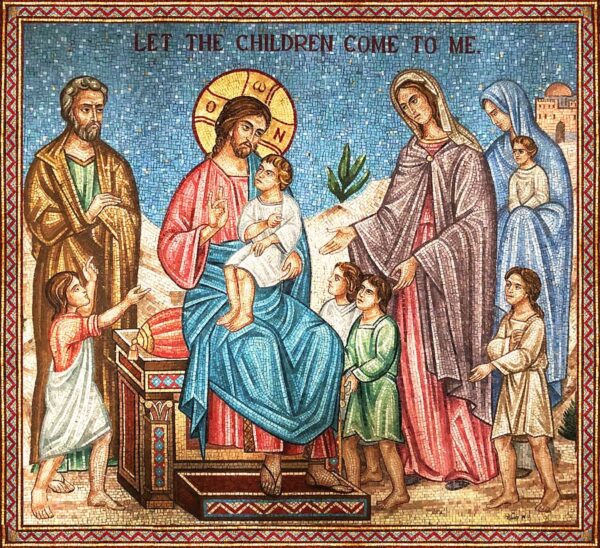
In today’s Gospel-reading, our Lord connects a lesson on humble church-leadership with praise for those who ‘receive’ children; specifically, little children. Think: not ideal little angels, but little ones who have little or no education, sometimes misbehave, speak out of turn, cry or want to play at inappropriate times, tend to get bored in church, and sometimes or frequently challenge the schedules or mindset of adults in other ways. If you read this chapter further, a few verses later Christ refers to simple or child-like believers as ‘these little ones,’ when He says: “And whosoever shall offend (skandalise in Greek, cause to stumble) one of these little ones that believe in me, it is better for him that a millstone were hanged about his neck, and he were cast into the sea.” (Mk 9:42) So, the big lesson and grave warning here is both to church-leaders and ‘whosoever’ is an adult in the faith, to treat gently those who believe, but lack in experience, knowledge or understanding.
In light of this passage, I wonder at the fact that in the Orthodox canonical codex, there are several ‘canons’ that prohibit offending clergymen and hierarchs (Canons ‘of the Holy Apostles’ 55 and 56), but none that prohibit, in those same terms, clergymen and hierarchs offending the faithful. There are canons that prohibit the clergy from scandalizing or driving to despair the faithful, in various ways, (e.g., Canon 3 of Nicaea I and Trullanum 102), but the instinct of church-leadership, in cases when a clergyman has ‘scandalised’ the faithful, seems still to be to protect ‘the good name of the Church’ not by protecting/defending his victims, but somehow covering for him.
Regardless of that, I’m thinking, what’s more important is how each of us, as Christians, whatever our church-status, can apply what the Lord is saying to us in this passage in our present-day context (not to sound preachy, because this is more of a ‘note to self‘). In the era of social media, when we might encounter ignorance, tantrums, or misbehavior in the posts and comments on a daily basis, it can be difficult not to get annoyed or not to respond abruptly. I’ll put it on a post-it for myself, just for today: “And whosoever shall offend one of these little ones that believe in Me…” Lord, help us, save us, and keep us, Your little children, by Your grace! ❤