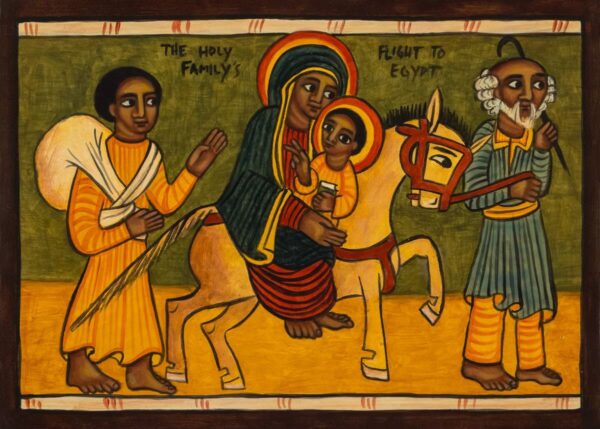
The prophecy quoted at the end of this passage, read today in OC-churches (one day after Christmas) is from Hosea, and it initially referred to the Exodus of the Israelites out of Egypt: “When Israel was a child, then I loved him, and called my son out of Egypt” (Hos 11:1). So, there’s a parallel seen here between our Lord’s flight to Egypt and the story of the Israelites in the Old Testament. I’ll remind you that they ended up in Egypt, because Joseph (the son of Jacob) was first sold by his brothers into slavery there; then he rose to power and was able to provide bread for his brothers during a famine. They were ‘called out of Egypt’ several generations later, under the leadership of Moses, after the Pharaoh died who was good to Joseph’s people, and they became slaves to the Egyptians.
In the New Testament, we have a different Joseph going to Egypt under different circumstances, not involving bondage. Wherein lies the parallel between the New and Old Testament stories? Christ is both sharing and re-doing the story of Israel, as a true Israelite: while He is compelled to go to Egypt under dire circumstances, He does not slip into bondage there. The Israelites had initially sought food in Egypt during a famine, and God provided them with food through Joseph, but they ended up slaves to the ‘bread-givers’ in Egyptian authority who came after Joseph. After their Exodus under Moses’s leadership, God provided them with the tools to un-learn slavery to human bread-givers (and to bread), by providing them with food-from-heaven (the manna) and with the Law. But eventually, they also became enslaved to the Law, as to some kind of idol, as we can see at the time of Christ’s earthly mission, when the Pharisees were entirely blind to the whole point of the Law and could not recognize the Lawgiver, Christ, in their midst. He, having been ‘called out of Egypt,’ challenged their rendition of the Law when He began to preach and do things like heal people on the Sabbath, reminding the people of the whole point of the Law, which was communion with Him, a ‘covenant’ with the Lawgiver, which did not enslave but freed from blind obedience to merely-human authorities.
Finally, He revealed Himself as our ‘Bread-Giver,’ by offering us His Body and Blood of the ‘new covenant.’ The point of that, again, is communion with Him and not enslavement to the merely-human rules and regulations that we have tended to construct around ‘canonical’ access to this Sacrament. The Bread of Life is not meant to empower church-leaders to ‘break communion’ at the drop of a dime with other churches, on the basis of church-political disagreements (as the Moscow Patriarchate did with the Ecumenical Patriarchate in recent times); nor is it meant to become an idol in and of itself, as it tends to become under the influence of popular renditions of ‘eucharistic ecclesiology.’ I mean, the kind of accentuation of the place of the Eucharist in church-life that tends to neglect all other aspects of church-life, lived by the people in between Sundays and feast-days. It leads to an episcopo-centrism and clericalism that tends to turn the people into passive consumers and the clergy into providers of the one thing that makes us Church. Anyway, sorry this was long and provocative, but these are my thoughts today, and let’s let ourselves be ‘called out of Egypt,’ also after the great feasts and in between Sundays, my friends.