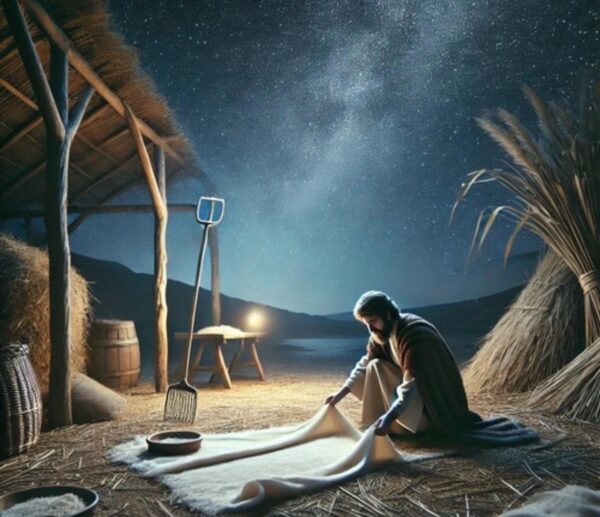
Gideon ‘put out a fleece,’ (which is an expression in English that means to ask God for a sign to confirm His guidance for a certain decision), that is, the wool that had been shorn from a sheep, onto a threshing floor; that is, an open flat area of ground, often elevated, on which harvested grain was laid out and ‘threshed’ or beaten out, so that the wheat would be separated out from the chaff. The lighter chaff would also be blown away by the wind, while the wheat was left behind. NOTE that in the Bible, a threshing floor is often a symbol of a certain separation or discernment-process, like our path of salvation. So, in this reading, Gideon puts out a wool fleece on a threshing floor overnight, and asks God for a sign, to prove that he, Gideon, will indeed save his people; he asks God to produce dew on the fleece only, while the threshing floor remains dry. And in the morning, Gideon finds the fleece wet with dew, as he had asked God, and the threshing floor is dry. But this isn’t enough for Gideon, and next he asks God to do the opposite the next night, for the fleece to remain dry and the threshing floor to be wet with dew. And God provides this sign as well, as Gideon discovers the next morning. So, he moves on to fulfill his vocation.
What does this incident have to do with the feast of Theophany? Well, Gideon’s sign involves three symbolic elements: (1) the fleece from a sheep, which is a symbol both of the Son of God, the Lamb of God, and of each of us, the sheep of the Good Shepherd, and of His and our obedience when we are ‘shorn’ like a lamb that does not resist that; and the other element is (2) water, which is always a symbol of grace, of the Living Water poured out on us, on the whole Church, by the Holy Spirit; and (3) there’s the threshing floor, which symbolizes several things. First, it’s the place of our whole discerning-process that is our way of salvation, and that place is this earth, the whole material world in which we live and through which we walk and make our way, even as God sanctifies us and this world, by sending down upon us and our world the ‘dew’ that is the grace of the Holy Spirit. Note in this context that, oftentimes in our church-hymns, the Mother of God who is the symbol par-excellence of the Church, the Church-Mother, is compared to the threshing-floor onto which the dew descends (яко дождь на руно…), because that’s a symbol of her being overshadowed by the Holy Spirit.
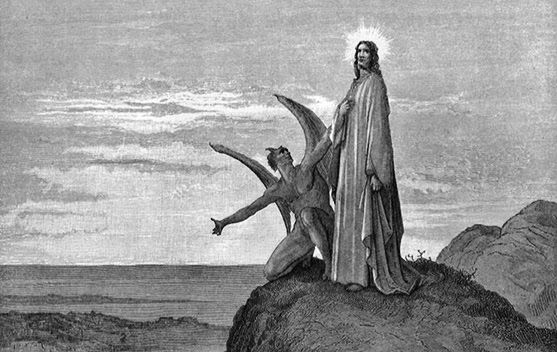
What does all this have to do with the feast of Theophany/Epiphany, also the Baptism of the Lord? Well, there’s water involved, and the Lamb of God is involved, namely, Jesus Christ in the waters of the Jordan, plus there is the Holy Spirit descending upon Him in the Jordan, in the likeness of a dove. And, let’s also mention, that Christ’s baptism inaugurates the beginning of His earthly mission, as the whole business of the dew on the fleece/threshing floor inaugurates Gideon’s mission. Our Lord does first go out further into the wilderness to be tested by the devil, immediately after His baptism, but then He returns and begins calling His apostles and preaching and healing and so on. Happy Eve of Theophany or Forefeast of Nativity to OC-people!